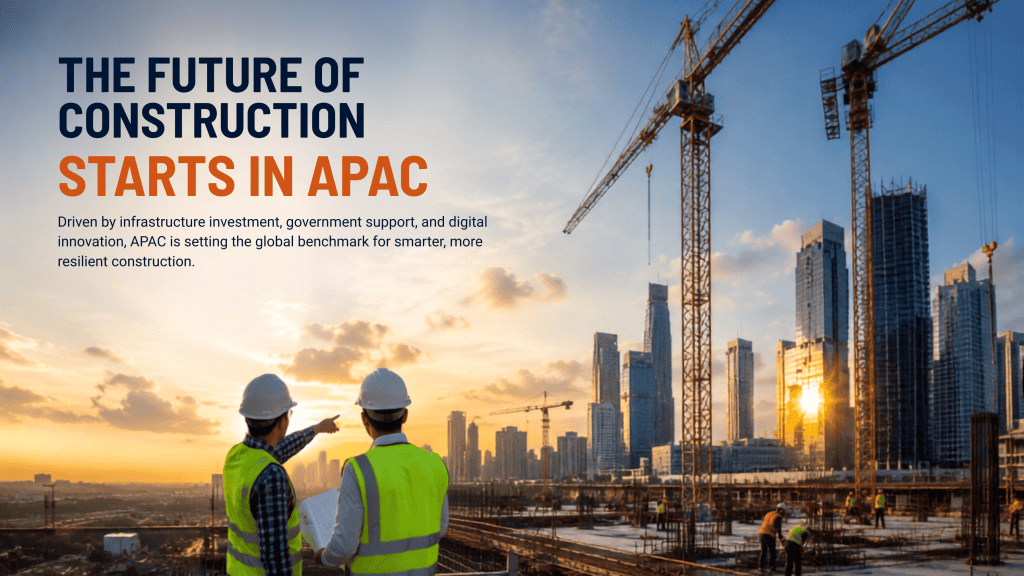
Despite many global challenges, the APAC region continues to outperform others due to a combination of structural strengths:
1. Strong infrastructure pipeline
Countries like China, India, Japan, Singapore, and Southeast Asia continue to invest heavily in:
- Transport infrastructure (rail, airports, highways)
- Urban housing and smart cities
- Energy and industrial projects
- Data centers and digital infrastructure
This consistent demand helps stabilize construction activity even during global downturns.
2. Government-led development models
Unlike many Western markets, APAC construction is driven by long-term government infrastructure planning, which reduces volatility and ensures a steady flow of projects.
Public investment acts as a buffer during global economic uncertainty.
3. Supply chain diversification advantage
APAC benefits from being a global manufacturing hub, especially for:
- Steel and materials
- Electronics and smart construction systems
- Prefabricated components
This provides the region with greater control over sourcing compared to import-dependent markets.
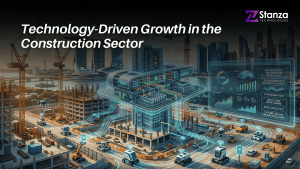
The Key Advantage: Technology-Driven Construction
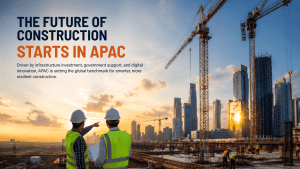
APAC’s rapid adoption of construction technology is the primary driver of its resilience.
Across the region, companies are scaling:
- BIM (Building Information Modeling) for coordinated digital design
- Prefabrication and modular construction to reduce delays
- AI-powered project management systems for forecasting and risk control
- IoT sensors and drones for real-time site monitoring
These technologies directly mitigate global risks by improving:
- Efficiency
- Predictability
- Resource allocation
- Safety and quality control
In summary, APAC is not only building more, but also building smarter.

How This Positions APAC Globally
Because of these combined strengths, APAC is now positioned as:
1. The global construction growth engine
The region is expected to remain the world’s fastest-growing construction market, driven by urbanization and infrastructure expansion.
2. The leader in construction innovation
With widespread adoption of digital tools and AI, APAC is increasingly setting the standard for:
- Smart construction systems
- Digital twin infrastructure
- Industrialized construction methods
3. The most resilient construction ecosystem
While other regions face stagnation or volatility, APAC sustains momentum through:
- Government-backed demand
- Integrated supply chains
- Technology adoption at scale
Global risks, including inflation, geopolitical conflict, and supply chain instability, are reshaping construction worldwide. However, APAC is turning these challenges into advantages.
Its resilience is driven by three pillars:
- Continuous infrastructure demand
- Strong government investment
- Rapid integration of construction technology
This combination positions APAC not only as a participant in the global construction industry, but as its most stable and forward-looking center for growth and innovation.