The construction sector in Singapore is experiencing another period of strong growth, with demand projected to reach as high as SGD $53 billion in 2026. This wave is being propelled by large-scale public infrastructure projects, including the expansion of Changi Airport Terminal 5, new MRT rail lines, healthcare facilities, and next-generation data centers.
Beyond the impressive figures, the most notable aspect is how Singapore is building, rather than what it is building.
A Government-Led Push for Smarter Construction
The Singapore Government continues to be at the vanguard of transforming the construction industry. Rather than depend solely on conventional methods, Singapore has aggressively embraced digitalization and innovation to address long-standing difficulties such as labor shortages, rising costs, and project delays.
This novel approach makes certain that increased construction demand does not happen at the expense of efficiency, quality, or sustainability.
Key Technologies Fueling the Industry
1. Building Information Modeling (BIM)
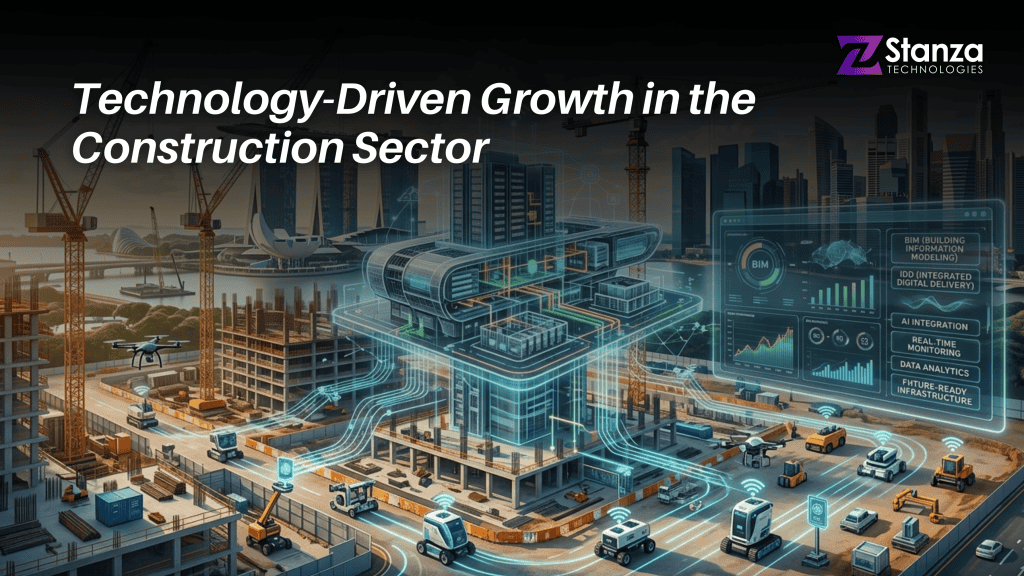
Building Information Modeling (BIM) is now central to Singapore’s construction sector, enabling architects, engineers, and contractors to collaborate using a shared 3D digital model.
Why it matters:
- Detects design clashes before construction begins
- Improves coordination across teams
- Reduces costly rework and delays
2. Integrated Digital Delivery (IDD)
Integrated Digital Delivery (IDD) extends BIM by connecting the entire construction lifecycle, from design and fabrication to on-site assembly.
Key benefits:
- Seamless data flow across all project phases
- Better project tracking and real-time updates
- Higher productivity with fewer manual processes
Singapore has been one of the leading adopters of IDD globally, establishing a benchmark for other Asian countries.
3. AI Integration in Construction
Artificial intelligence is being integrated into multiple aspects of construction, from planning to execution.
Applications include:
- Predictive analytics for project timelines and risks
- Automated site monitoring using drones and sensors
- Resource optimization to reduce waste and cost
AI enables construction firms to shift from reactive problem-solving to proactive decision-making, significantly improving efficiency.

Building More Than Infrastructure
Singapore’s approach demonstrates that modern construction is not only about physical structures but also about building smarter systems.
By combining strong government leadership with cutting-edge technologies like BIM, IDD, and AI, the country is:
- Increasing productivity despite workforce constraints
- Enhancing accuracy and reducing costly errors
- Creating an increasingly sustainable and future-ready built environment
As demand rises, Singapore demonstrates that development and innovation can progress together. Its commitment to digital transformation in construction positions the country as both a regional leader and a global model for efficient, technology-driven development. For countries in Asia seeking to expand infrastructure without jeopardizing quality, Singapore provides a clear blueprint: invest in technology, integrate systems, and lead with vision.